• Categories
Collapse

The Silver Fern

MaussM

Mauss

@Mauss
About
Posts
540
Topics
2
Groups
1
Followers
0
Following
0

Posts

Recent Best Controversial

    Blues 2026
  • MaussM Mauss

    I thought Marco Miln (Kings, halfback and first five) was one of the few players who came out of that U18 Trans- Ta$man demolition with his reputation relatively intact.

    Needs to quicken his delivery and the execution wasn’t always there but he’s got vision and athletic ability. A good foundation to build on.

    I’d think (and hope) the Blues will have identified him as potentially an important future piece.


  • NZ U20s 2026
  • MaussM Mauss

    @Bovidae said in NZ U20s 2026:

    I've no idea on the DOB of these players. Do you think that Raharuhi Palmer is still eligible in 2026? If so, he would be like Micah Fale and a young Y13 when he finished school.

    If the PUs or SR clubs released a list of their players who are part of the U20 testing group, we'd know who they are looking at.

    Yeah, I’m nearly certain that Palmer is still eligible. He played for both the NZ Barbarians and Māori U18 in 2024, and all of those players are born in ’06 or later.

    As a general rule of thumb, I tend to look at the SR U18 development camp lists from two years earlier (so, in the case of the 2026 U20 season, the 2024 camps). All of those players are U20 eligible in 2026. The issue is when certain players miss out due to not being on the radar or being injured. Then the puzzle work begins.

    But you’re right, it’d be a lot easier if teams would just release their U20 groups. I’m not holding my breath, though.


  • NZ U20s 2026
  • MaussM Mauss

    @Bovidae said in NZ U20s 2026:

    Dane Johnston's selection came out of nowhere as he was only a reserve for the Chiefs U20s until injury, and he was in his first year out of school. Faauma Kupita was the starting TH until he got injured. I would have selected him for the NZ U20s if he was fit by then. Now that Johnston has a NDC I would hope to see a big improvement in his development. Riley Tofilau should also have been chosen to improve the scrum.

    I am puzzled why the NZS or NZ U20 coaches want to make some props play in an unfamiliar position in a black jersey. Henry Hunter was another who was played at TH for NZS in the 2nd test.

    I'm not sure if the new selection pathway will identify the best props as there looks to be less opportunity to see these players on the field before they play in those wider squad games. Who do you think the LH props could be? James Moore and Charlie Wallis were the 2024 NZS LH props.

    Speaking of Faauma Kupita, do you happen to know if he's still eligible for next year's U20s? He still played in the U19 competition for Bay of Plenty this year but he wasn't selected for any of the 2024 Chiefs U18 camps so I kinda figured he's a late '05 birth.

    Dane Johnston is an interesting one. He seems to be really highly rated by some, while being much less so by others. He had the Taranaki-connection with Hoeata as well, so with both him and Dunlea out of the picture, it might be a different story for him this year. I think he’s a solid player around the park but I wouldn’t pick him as long as he can’t considerably improve his scrum performances.

    In terms of the looseheads, I thought Palmer, Wallis and Qaranivalu stood out most positively. Palmer can take a while to get into the game, scrummaging wise, but once he’s firing he’s a difficult player to stop. Wallis can be a bit of a lottery at scrumtime but I like his aggression, both in the scrum and around the field.

    Qaranivalu isn’t a very aggressive scrummager (only 6% dominance) but I was impressed by how he was able to deal with different types of tightheads. Seems to be a technically astute scrummager, who can avoid being penalized even when coming under pressure. He wasn’t penalized once in the 51 scrums I’ve seen him engage him, and he came up against some solid tightheads.

    I can’t say I was all that convinced by James Moore, either for CBHS, NZ Schools or Canterbury U19s. His strengths probably lie more outside of the set piece.

    As far as selection is concerned, I’d probably pick two units based on height: a short one to really attack the opposition scrum (Palmer/Leota/Tulimanu) and a taller, more all-round one (Qaranivalu or Wallis/Wharehinga/Ahloo). A tighthead-axis of Tulimanu and Frazer Brown behind him would have both a lot weight and pack a good punch.


  • NZ U20s 2026
  • MaussM Mauss

    Will the NZ U20s finally have a stable scrum platform in 2026?
    A recurring question with the NZ U20s is whether they will have the set piece platform to compete with the big packs of South Africa, France and England. It’s a question that fascinates me, which is why I watched a lot of scrums from NZ U20 eligible props these past few weeks, to get some insight into the matter. After reviewing the footage, my personal verdict was that they could get a stable scrum platform but getting selection right as well as healthy props would be critical. There is not a lot of depth right now and there are some structural issues within the NZ rugby pyramid blocking the creation of further depth.

    The data
    So how did I try to gain this insight into the propping stocks? The short answer: by watching a ton of scrums. I watched a minimum of 15 scrums per prop, looking at a total of 23 NZ U20 eligible loose- and tightheads. My goal was to get an impression of two things: are they able to scrum within the limits of the laws, and are they able to exert any sort of dominance? In other words, I exclusively considered their ability in the scrum; whether they can tackle, carry or clean isn’t taken into account here.

    I tried to keep my selection of props as broad as possible: players who were selected for NZ U18 rep teams, provincial U19 teams as well as SR U20 teams, all of those came into the frame. There were only 2 real limitations for players to come into consideration: they needed to be born on January 1st 2006 or later (which wasn’t always easy to figure out). And second, there needed to be available footage of them scrummaging. Due to this condition, players like Apai Ma’u Hinkes (North Harbour) and John-Paul Schmidt (Auckland) weren’t included, despite their promise and potential, as I simply couldn’t find enough film of them scrummaging.

    When watching these scrums, I mainly noted whether the props were penalized and whether or not the scrum was moving forward. Since scrums are notoriously difficult to fully comprehend, I did not try to distinguish between who was actually at fault. For example: if Dane Johnston was at tighthead and part of a scrum that folded but the ref indicated that it was the loosehead who collapsed, I still counted the penalty against Johnston. While this isn’t particularly fair, it allows me to simply measure whether props are part of successful scrums, as a kind of external measuring point. In order to combat any false perceptions, I made sure to watch scrums from different match settings for a single player, where he scrummed with different teammates. This should’ve balanced the overall picture.

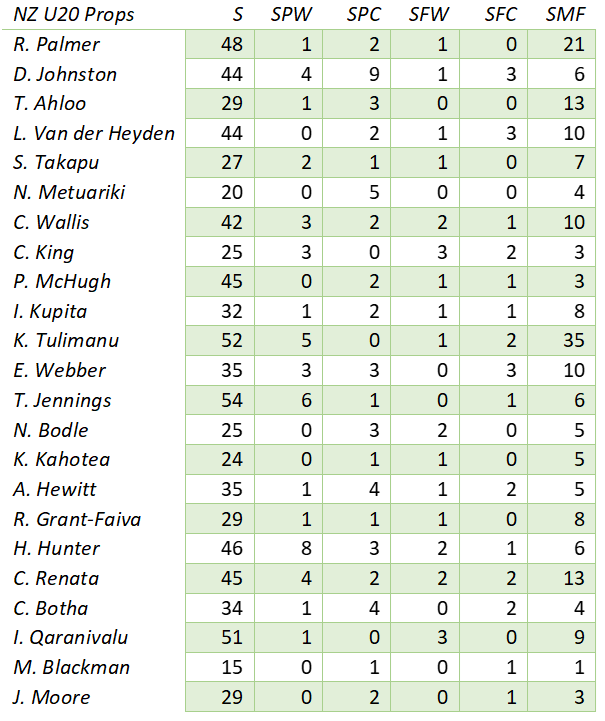
    Scrums are as much about perception as anything else; I was more interested in these perceptions as well as the referee’s interpretations of these pictures as a way of gauging the NZ U20 propping stocks. Gathering this information (was the scrum penalized? Did the scrum move forward?) eventually resulted in this table, a total of 830 non-unique scrums that included 23 NZ U20 eligible props.
    98bb2ac4-9fc5-4e72-8afb-e8538d989244-image.png
    Listed here are the props, the number of their scrums I watched (S), their scrum penalties won (SPW), conceded (SPC), free kicks won (SFW), free kicks conceded (SFC) and how often their scrum moved forward (SMF)

    Based on both the viewing of these scrums as well as the results they brought forward, I was able to formulate two predominant findings: (1) there is a dominance issue within NZ rugby, and (2) representative selection strategies do not sufficiently prioritize set piece excellence.

    Finding 1: the dominance issue
    The easiest way to build a successful scrum is to find a tighthead who is not only able to keep up the scrum but who is also able to move his pack forward as well. While these forward movements might not always be fully legal, they present the picture of a dominant scrum, which most referees find difficult to ignore.

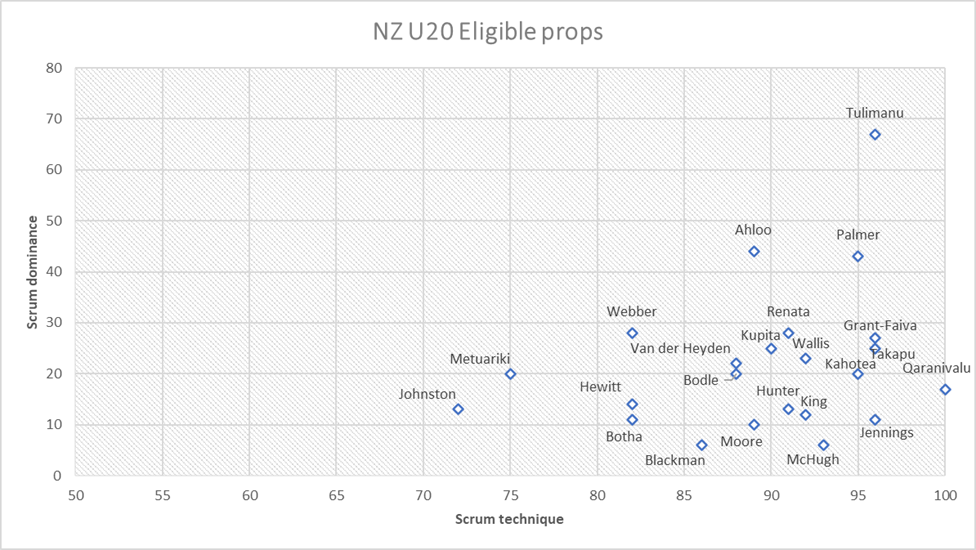
    And yet, remarkably few props within NZ age grade rugby seem interested in such forward momentum, preferring instead to take a conservative approach of keeping the scrum up and letting their opposites make a mistake. The following graph, based on the data from the table above, further emphasizes this trend.
    10861f1b-cb69-4cd7-bff4-df243e4d0e11-image.png
    Westlake man-mountain, Kaiva Tulimanu, is the exception that proves the rule, with most props preferring to prioritize scrum technique over scrum dominance

    Kaiva Tulimanu has been a dominant force in age grade rugby, not just in his bullish carries but in his scrummaging as well, moving forward in his scrums at an excellent rate of 67%. And yet his exceptionality is damning: while Ahloo and Palmer still show decent aggression in their scrummaging (at 44 and 43% respectively), nobody else cracks even the 30%. They prefer to simply keep the scrum up (‘scrum technique = percentage of scrums completed without conceding a penalty or free kick’) and make sure the ball gets away safely.

    The refereeing of the scrum, especially by NZ referees, plays a considerable part in this. Watching all of these scrums throughout different age grade competitions – First XV, U18 rep games, U19 provincial competitions, and the SR U20 tournament – it becomes obvious that NZ referees (1) are more or less fine with messy scrums, and (2) are very hesitant to reward scrums for their dominance. If the ball is in any way playable, refs will want to keep the game moving.

    One of the clearest examples that I encountered of this, was in the 3rd/4th playoff at the National Top 4 tournament this year, between Westlake Boys’ and Southland Boys’. Throughout the game, Tulimanu put his opposite, Presley McHugh, pretty much through the wringer, moving forward at will, both on his own and on opposite feeds.

    Tulimanu vs. SBHS I
    Tulimanu vs. SBHS II
    Tulimanu vs. SBHS III
    Rarere, the SBHS 9, is feeding the scrum nearly at the feet of the number 8 in order to get the ball away, yet wasn’t penalized once for this. Nor was the collapse in the final example

    The game was played in windy and wet conditions, where territory was absolutely crucial. Yet, Westlake didn’t get any benefit from their set piece dominance, not being awarded a single penalty from the scrum throughout the game, despite being completely on top in this area. As a result, Southland didn’t suffer any territorial disadvantages and were able to win the game, 21 to 19.

    It is at this point that the structural issue causing the lack of dominance becomes more apparent. Kiwi refs very rarely penalize any other indiscretion at the scrum apart from the collapse. Hookers popping out of the scrum, tightheads boring in, looseheads losing their binds, brake foots not being placed properly: a NZ ref will tend to ignore these things, if the ball is playable. This was further underlined when Tulimanu would once again face off against McHugh, this time in the game between the NZ Barbarians U18 and Māori U18, with the same result: dominance for little reward.

    Tulimanu vs. McHugh v2
    The Māori U18 scrum isn’t able to take the hit yet the ball is still deemed to be ‘playable’

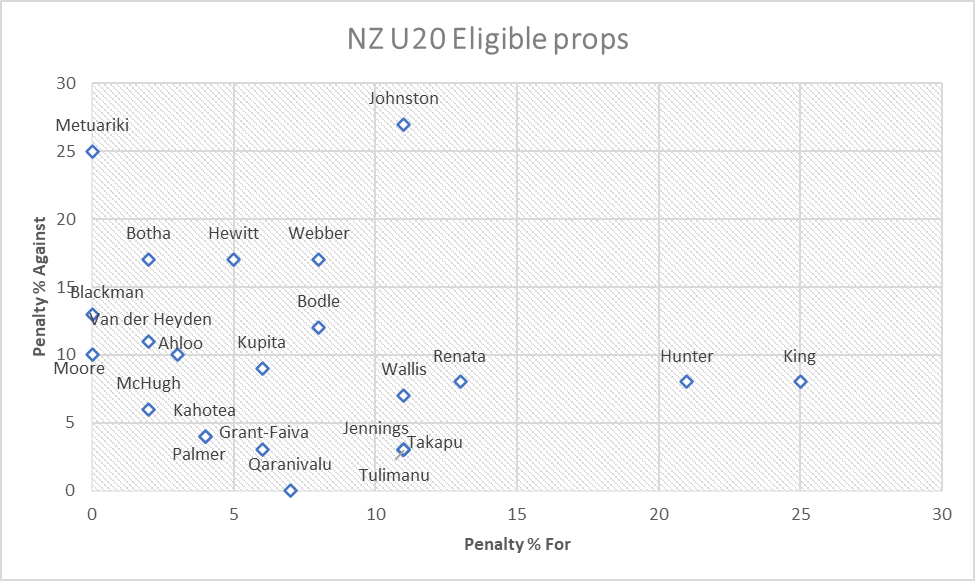
    This also explains why two of the least ‘dominant’ scrummagers, Corban King (12% dominance) and Henry Hunter (13% dominance), were rewarded the most at scrum time: their opposites were deemed to collapse the scrum.
    0cd91a24-3817-4b16-9a5a-0181ffcc797f-image.png
    Not moving forward but still being rewarded: Hunter and King reaped the rewards of their set piece conservatism

    While there is no fundamental problem with simply keeping up the scrum as a set piece tactic and prioritizing playable ball, there are, however, several contingent problems this creates. One of those already mentioned is the lack of incentive for set piece dominance. A player like Tulimanu isn’t sufficiently rewarded for his scrummaging dominance so why would First XV coaches emphasize a set piece that is coherent and moving forward if it doesn’t deliver anything in the long run? As long as the scrum sort of holds up, no matter how ugly, chances are you won’t be punished for this.

    The downside of this lack of incentive is that NZ rugby isn’t producing enough polished props who want to be dominant in the scrum. A second yet related problem is the difference in how the scrum is policed at World Rugby-level: in contrast to NZ refs, non-Kiwi refs are much more strict on the finer details of the scrum. As a result, simply producing playable ball is no longer deemed enough: the scrum needs to be able to take the hit and present a stable scrum before the ball is deemed playable.

    For example, in the game against Georgia at the U20 World Championships in Italy, the NZ U20 scrum struggled, not just because of the strength of the Georgian scrum but equally because of the technical rigour and eager whistle of the Italian ref, Filippo Russo.

    NZ U20 scrum vs. Georgia I
    NZ U20 scrum vs. Georgia II
    First, the ball has already left the Georgian scrum (and is, thus, obviously playable) yet the ref still awards them a penalty for dominance. And in the second, Johnston is penalized for binding early for a second time, a very technical offence that simply doesn’t get penalized in NZ age grade rugby

    NZ props aren’t sufficiently prepared for this kind of technical rigidity by their own refs, who simply let too much slide and who aren’t willing to sufficiently reward scrum dominance. Equally, it immediately brings us to a second finding, which is the inability of NZ Rugby to take this refereeing discrepancy into account with their selection strategies.

    Finding 2: failed selection strategies at the national level
    There is substantial evidence that NZ selectors – both for NZ Schools at U18 level and for NZ U20s – simply do not place enough value on the worth of a dominant scrum. The key term seems to be, once again, ‘playable’: it is deemed sufficient if the scrum can hold up on its own feed and deliver playable ball to the backline, especially if it means the possible selection of mobile props. Sika Pole, Robson Faleafa, Dane Johnston, Logan Wallace, Bradley Crichton, Ben Ake, Gabe Robinson (just to mention a few) are all props selected for the U20s in the last few years who had obvious difficulties in the scrum but were still selected for the team, due to their ball-in-hand abilities.

    Johnston is probably the most glaring example in recent years. Regularly penalized at all levels – whether playing for Feilding (First XV), NZ Barbarians U18, or Chiefs U20 – Johnston was still selected as an under-ager for the NZ U20s this year, with rather predictable results. The Taranaki prop typically struggles to properly balance his weight after the bind, often leading to the collapse.

    Johnston scrum for Chiefs U20
    Johnston losing his feet after the engage

    Despite this tendency, Johnston was still selected for the NZ U20s and played each game at the U20 World Championships. While he was regularly penalized at tighthead (3 penalties across 4 games), it was when he was used as a loosehead in the opening pool game against Italy that things really went south. In a close and tense affair, Johnston put in a 20 minute-cameo where he was penalized three times for collapsing the scrum, giving Italy opportunity after opportunity to get back into the game.

    Johnston vs. Italy U20 I
    Johnston vs. Italy U20 II
    Johnston vs. Italy U20 III
    Being in the unfamiliar loosehead position, Johnston is unable to control his weight after the hit

    While Johnston isn’t a particularly reliable tighthead, the NZ selectors decided to further compound their set piece insecurity by putting him in an unfamiliar loosehead position. This, what can only be termed as a lack of respect for scrum specialists, is a theme which returns again and again in national selection strategies.

    Changing from tighthead to loosehead (or vice versa) can turn a strong scrummager into a set piece liability. Two other examples of this ill-advised selection strategy are Tamiano Ahloo (Auckland, Blues) for the NZ U20s and Cody Renata (Waikato, Chiefs) for NZ Schools: both are strong tighthead scrummagers who were put in an unfamiliar loosehead position, with poor results.

    Their set piece strength at tighthead, however, was easily apparent. Ahloo, for example, put in a strong showing for NZ Barbarians U18 against the highly-fancied Kingsley Uys from Australia U18s, while Cody Renata was consistently dominant alongside a hefty Rotorua forward pack all the way through to their National Top 4 title.

    Ahloo at tighthead vs. Australia U18 I
    Ahloo at tighthead vs. Australia U18 II
    Renata at tighthead vs. Feilding I
    Renata at tighthead vs. Feilding II
    Stability and strong go-forward momentum: while scrum dominance might not always be fully legal (with Renata seemingly angling in), it creates a positive picture in the referee’s mind

    Both Ahloo and Renata were undoubtedly selected with these performances in mind. When picked for their national rep sides, however, they were put at loosehead. Plenty of props have already commented how difficult it is to switch between the two positions, with Angus Ta’avao’s particular metaphor being perhaps the most memorable – “It's a whole different side of your body. Imagine going to the toilet and being right-handed, then you've got to use your left hand, so it's like little things like that” (Ta’avao, 2019).

    Both Ahloo’s and Renata’s performances further proved Ta’avao’s point: Ahloo and Renata both struggled to keep their balance in the scrum, their body dynamics clearly not used to the hit on the other side of the scrum.

    Ahloo at loosehead vs. Australia U20 I
    Ahloo at loosehead vs. Australia U20 II
    Renata at loosehead vs. NZ Barbarians U18 I
    Renata at loosehead vs. NZ Barbarians U18 II
    The selection policy falls flat: both Ahloo and Renata are unable to hold up their unfamiliar side of the scrum

    These selection strategies aren’t without consequences, either. In both games – NZ U20s vs. the Junior Wallabies at the 2025 U20 TRC, and NZ Schools vs. NZ Barbarians U18s – these faltering set piece platforms set the stage for opposition comebacks, with the NZ Barbarians just falling short whereas the Junior Wallabies were able to salvage a draw after being behind by 12 points and being down to just 13 men at a certain point.

    It points to a high-performance unit at NZR which is both being impeded by the system it put in place as well as its own selection strategies, which refuse to take into account the reality of World Rugby’s more strict refereeing framework for the set piece.

    There’s a saying often attributed to South Africa’s Danie Craven, the legendary coach and administrator, about how the first person selected should be the tighthead and the second the reserve tighthead. The new ‘Doc’, Rassie Erasmus, has shown no hesitation to listen to and borrow from Kiwi rugby culture in areas such as counter-attack, leading to success at both senior (TRC) and junior level (U20 World Championship). It’s about time NZR listens to some wisdom from the Republic and put more emphasis on set piece dominance.

    As far as selection is concerned, the options seem relatively straightforward to me: it’s Kaiva Tulimanu and Tamiano Ahloo as your two premier tightheads.

    Summary, or tl;dr
    Can the NZ U20s have a stable platform in 2026? I believe so but only on the condition that the NZ selectors get it right and select for dominance. There is not a lot of propping depth in NZ rugby right now, mostly due to playing philosophy, refereeing standards and selection issues. But the cream still rises to the top, and a few props can put in a good showing, I believe, if selected and put in their natural position.

  • School Rugby 2025
  • MaussM Mauss

    I watched the boys’ final. The contrast with the 2024 encounter, between NZ and Australia U18, was quite stark, I felt. It was almost a reverse of last year’s match-up: now, it were the NZ U18 Boys who looked very well-prepared for their opponents, kicking in behind towards the space multiple times (Erasmus and Jones) and putting pressure on the opposition breakdown (Tuituba, Raviyawa, and Solomona all had breakdown steals).

    https://giphy.com/gifs/b8p4PdMs9DFCGPuTwe
    https://giphy.com/gifs/Q7mSVWpYFY0iQoPJl4
    Using the outside of the boot while moving the kicking leg away from opposition contact: both Erasmus and Jones used similar techniques to put in effective kicks

    Last year, I also remarked that the Australian U18s keep unearthing these tall, rangy athletes like Declan Minto and Cooper Watters who are remarkably effective at this level. This year, NZ U18s followed suit with what must’ve been the tallest squad they’ve assembled, with all of Hutchings, Neilson, Raviyawa, Fleming and Erasmus being close to 1m90 or taller.

    They showed their value throughout these games, being able to break through tackles (Turinui noted Fleming’s hip strength as a key to this) as well as offload in contact.

    https://giphy.com/gifs/TMYLOG36Or2nzklUMU
    https://giphy.com/gifs/HKNz74vthsp4yoNEqw
    Both Fleming and Raviyawa used their hip strength and length to stay alive and offload after contact, both offloads leading to tries

    After last year’s relatively poor showing at the Global Youth 7s as well as the drubbings received by the NZ Schools team at the hands of the AU U18s this year, it was good to see some more astute selection and coaching decisions by NZ Rugby.


  • NZ U20s 2026
  • MaussM Mauss

    @DurryMexted said in NZ U20s 2026:

    Couple this up with the fact that barely any young (<25) 10s get given the keys to a super team, its a hard slog to commit to for guys coming through these age grade sides.
    Of all the positions to be as a young professional rugby player in NZ, 10 would have to have the worst pathway to the next level.

    Good post. We might be veering a bit off-topic here but I do think selection, and particularly long-term selection strategy, plays a big role here. A first five-eight is the kind of player you need to invest in and that means to stick with them when they’re struggling to adjust to the speed of the game. There just hasn’t been enough investment in young 10s.

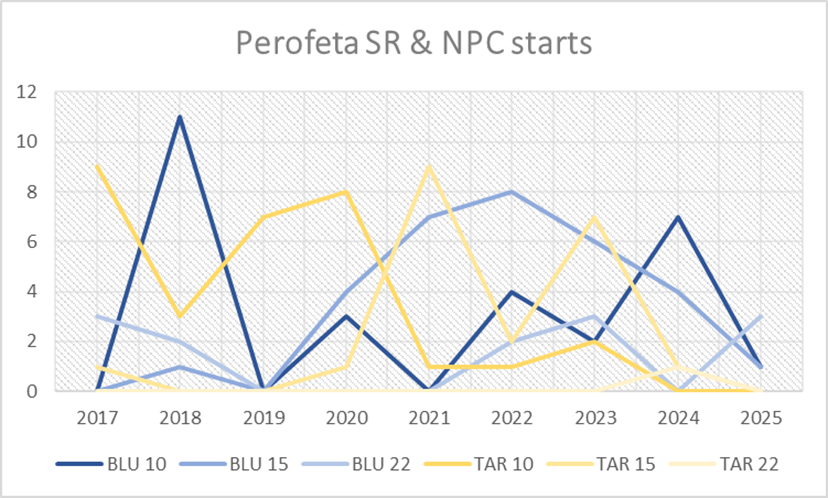
    Looking back, you’d say a player like Stephen Perofeta had all the tools to be an excellent 10 from a fairly young age: he’s got a good tactical brain, he’s a great runner of the ball and he has all of the ball-in-hand skills required. He was also identified as a player with great potential very early on, as he played two years of U20 rugby and started for the Blues at first five against the British and Irish Lions as a 20-year-old.

    So what went wrong? Perofeta obviously has had his injury issues but I would say the lack of consistent selection at first five played a massive role as well. And here, the high performance conundrum that is the Super Rugby and NPC combination, comes to the fore again as well. From the very beginning, there was no clarity, either for Taranaki or the Blues, whether Perofeta was going to be a first five or a fullback.

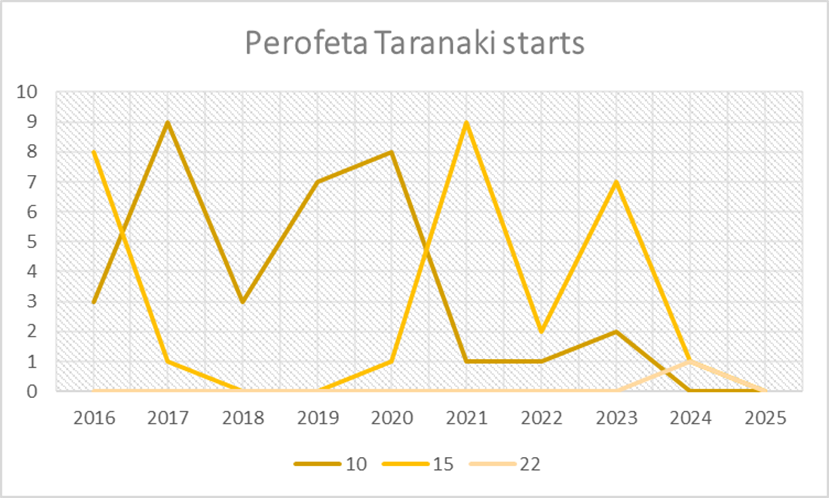
    For Taranaki, he started as a 15 before quickly transitioning to their preferred starting 10, only for him to switch back to fullback around 2021.

    68d1ad2f-0629-46ce-937f-865b1486320b-image.png
    Perofeta’s starts for Taranaki: there at fullback and back again

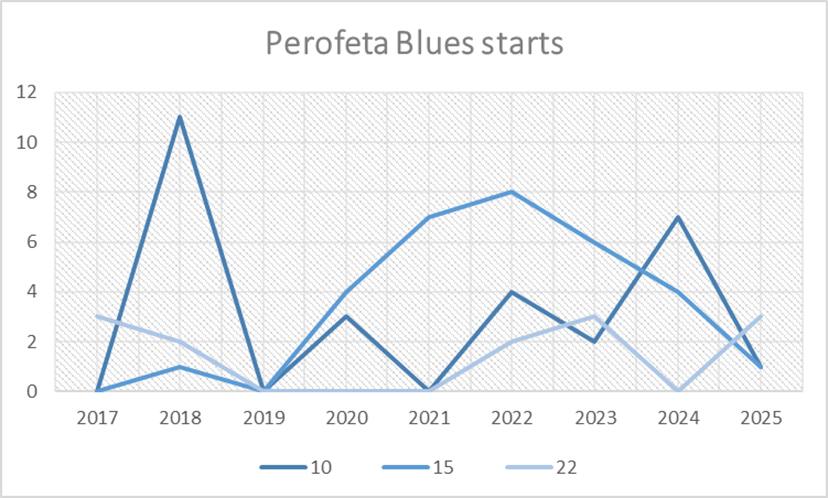
    For the Blues, Perofeta first started on the bench in the 2017 season, only for him to become the first-choice 10 for the 2018 season. His 11 starts at first five are still the most he’s had in one jersey for a Blues season, and that at 21 years of age. Afterwards, he would mostly shift between 10 and 15, the sole exception coming in the 2021 season, where he exclusively started at fullback. In 2024, he would start most of his games that season at 10, only to shift back to fullback during the playoff rounds.

    93d36b37-759e-48a4-9463-20c3997aeab3-image.png
    Perofeta at the Blues: a 10 shifting to fullback (and back again?)

    Further compounding this positional vertigo is of course the fact that Perofeta would often not only shift between positions during the season but between teams as well. A good example of this is the 2020 season where Perofeta started at 10 for the Blues only to be shifted to fullback later on, with Otere Black becoming the preferred first five. But when the Whanganui playmaker would then turn up for Taranaki in the NPC, he’d play nearly exclusively at first five once again that season.

    66b45597-37bb-4422-a8aa-3a8f78ff3e0c-image.png
    Perofeta’s combined starts for the Blues and Taranaki. I haven’t even added his AB and AB XV appearances, which would even further muddle this already chaotic chart

    How would a player like Perofeta ever get comfortable in his role directing a team, if he’s constantly being shifted from one position to the other, from one team to another? Perofeta’s pathway is fine if you want to create the ultimate utility back, someone who can slot in for either playmaker role or take up a slot on the bench. But why would you want one of your most promising first five prospects to become a utility back?

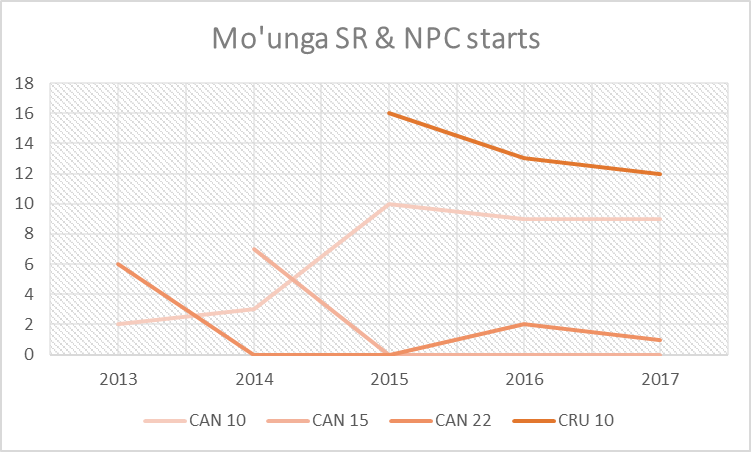
    That Perofeta was never destined for the AB 10-jersey becomes further clear when we compare his positional chart with that of Richie Mo’unga. Whereas Perofeta’s story (one he shares with most of his U20 first five peers) is one of constant rotation, Mo’unga’s, on the other hand, is about as straightforward as it gets. Start from the bench in the NPC, play some 10 and 15 in your first full season and then you stick to what’s working. Mo'unga, in his three Crusaders seasons leading up to his AB selection, only ever played in the 10-jersey for them.

    b468c978-c868-4e08-acc5-70adfbf54993-image.png
    Mo’unga’s SR and NPC starts: those straight lines lead to the All Blacks

    I don’t think NZ Rugby has a talent-problem at first five; it has a selection-problem. When talented players like Stephen Perofeta get muddled around, you end up with a utility back, not a well-rounded first five who is ready for Test rugby.

    There is an important lesson here, I think, when it comes to versatile players like Damian McKenzie and Ruben Love: while this versatility gives you early access to higher levels, in the long-term that versatility can easily turn into a poisoned chalice (I’ve no doubt that Ruben Love’s charts would look a lot more like Perofeta’s than Mo’unga’s). It is best to pick a position and to stick with it as best as possible, both at SR- and NPC-level. Otherwise, the best you can probably hope for is that AB 22-jersey, instead of the coveted number 10.


  • NZ U20s 2026
  • MaussM Mauss

    Recently, I watched a bunch of games featuring Mika Muliaina – ranging from his First XV appearances for Southland Boys’ High to some of his recent showings for the Stags in the NPC – as I wanted to familiarize myself a bit with his game and see what kind of first five he actually is.

    The thing that stood out to me was Muliaina’s patience. He doesn’t try to create a line break every time he gets the ball – an affliction young 10s can occasionally suffer from (see: Rico Simpson, young Damian McKenzie) – but is more than willing to just keep the ball moving, waiting for an opportunity to eventually present itself. And when these opportunities do present themselves, Muliaina has shown the ability to make the final pass.

    https://media2.giphy.com/media/v1.Y2lkPTc5MGI3NjExcGZtNGxsMHV5d2p0bmUyNmhwaTEwZmN6bW1hMnp6MGpzbWNmOWg5aCZlcD12MV9pbnRlcm5hbF9naWZfYnlfaWQmY3Q9Zw/6TRxn3OWxuLU6MLpgp/giphy.gif
    https://media1.giphy.com/media/v1.Y2lkPTc5MGI3NjExcXY3NTNienVqNm1oeHdoY25wOGJnMmthdGE0dHVrbGxnZHZseGtrZiZlcD12MV9pbnRlcm5hbF9naWZfYnlfaWQmY3Q9Zw/JpPvTQjMoKJrOUucp4/giphy.gif
    Muliaina is patient for both scores, letting the forwards contract the opposition defence through multiple carries up the middle, before pulling the trigger for the easy score

    Muliaina is, in other words, a facilitator: someone who uses his vision and distribution abilities to put others into space more than looking to attack the space himself. The stats, across the different high performance-levels, further back this up.

    dabe90eb-1767-486d-b68e-df08fe36c0e2-image.png
    Some of Muliaina’s per80 numbers: kicking, passing, running, defenders beaten, tackles completed, try assists and line break assists. All stats are my own, apart from those from the NPC, which I took from RugbyPass

    Muliaina has relatively low run numbers, especially when comparing him to some of his U23 peers like Rico Simpson (9.1 r/80), Harry Godfrey (9.3 r/80) and Lucas Cashmore (7.1 r/80). But what he perhaps lacks as a running threat, he makes up for in distribution, with high passing numbers (26.7 p/80 in the NPC) as well as solid line break assist-production (2.8 LBA/80 in the SR U20 tournament).

    While Muliaina can sometimes be a tad too passive in attacking the line, he is at his best when paired with another genuine gamebreaker in the spine (Dylan Pledger for the Highlanders U20s; Jimmy Taylor for Southland Boys; Rios Tasmania for the NZ Barbarians U18s). A combination with someone like Cohen Norrie, the diminutive Auckland fullback, seems likely, with Norrie a lethal attacking threat with time and space at second receiver.

    https://media3.giphy.com/media/v1.Y2lkPTc5MGI3NjExcmt6OXU4em1vOGNqNTQ0a3Rianl5dmdsaGJyZjg0dG1jd2s2ZjgwdiZlcD12MV9pbnRlcm5hbF9naWZfYnlfaWQmY3Q9Zw/VJW6CFcpKkTFYyTM6L/giphy.gif
    https://media2.giphy.com/media/v1.Y2lkPTc5MGI3NjExNGk2NnhtOGpsNGNoamI3aTMzNHg4MmRnZmRyNHpkdWowdGtwaXp0ZCZlcD12MV9pbnRlcm5hbF9naWZfYnlfaWQmY3Q9Zw/QOPU7YIuonKAIHqICW/giphy.gif
    Norrie is great at using his speed to isolate defenders, being able to both cut back inside and connect or burn them on the outside. He could form a potent combo with Muliaina, with the latter putting Norrie into space

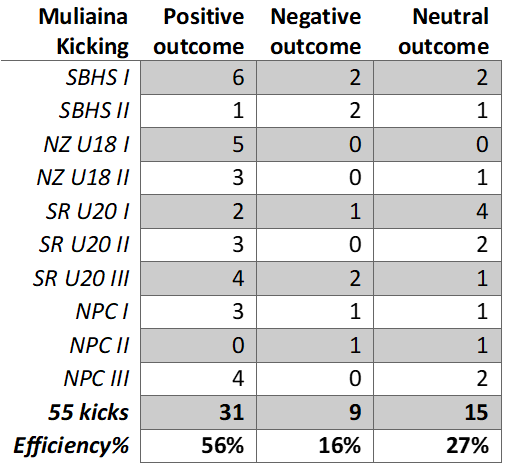
    It is when combined with this kind of X-factor that the value of a player like Muliaina truly comes to the fore, as he excels in one of the core areas of first five-play, territorial kicking.

    37eb05f4-78d7-473e-892b-5af70eb5f547-image.png
    Muliaina’s kicking outcomes across multiple games and levels (First XV, U18 rep rugby, U20 rep rugby and senior rep rugby). What distinguishes outcomes is based on territory: if the kick moves the team closer to the opposition goal line, then the outcome is a positive one

    Of the 10 games, only two didn’t result in a net positive outcome: one against Australian school St. Augustine’s College at the Sanix Tournament in Japan, where SBHS decidedly overplayed ball-in-hand due to the warm conditions. And the second against Ta$man in the NPC, where Muliaina again failed to change up his game, as the Southland attack became much too lateral against a staunch Mako defence. Muliaina wasn't yet as efficient for Southland in attack as he could be, as much of the kicking was taken up by Shearer and Peni. Doing this, however, takes away one of Muliaina's main strengths.

    When Muliaina does decide to go for the kick-option, more often than not good things tend to happen. While this occasionally results in a spectacular gain, like a 50/22, most of the time these kicks simply move the team into better areas.

    https://media3.giphy.com/media/v1.Y2lkPTc5MGI3NjExMGZzeWNtdWhqOWpndWozcm54dXhxaWlqMjg0M296YjhkZHcxam9vbyZlcD12MV9pbnRlcm5hbF9naWZfYnlfaWQmY3Q9Zw/muKIgKb3CzaupC5d44/giphy.gif
    https://media1.giphy.com/media/v1.Y2lkPTc5MGI3NjExczRrdzl2ZndydGZ3NThvbmVnYnpjMXZwZzI2MzNoYmZhbzAyb2pudyZlcD12MV9pbnRlcm5hbF9naWZfYnlfaWQmY3Q9Zw/2H1rsDvF3t1rHB3UG1/giphy.gif
    Muliaina is able to kick long which, if coupled with a solid chase, can lead to substantial territory gains

    These aren’t particularly highlight-worthy pieces of play but they represent a skill which has often been undervalued by NZ 10s in recent years, which is to just kick accurately and with distance. His 56% of positive outcomes is testament to that, while his relatively low percentage of negative outcomes (16%) means that a high-volume kicking game is a real option for the NZ U20s.

    Muliaina’s touch finders are another good example of this: the Southland first five is able to put his team into the opposition 22 from penalty advantage more often than not, which is massively beneficial for any attack, either to go to the maul or a lineout strike play.

    https://media4.giphy.com/media/v1.Y2lkPTc5MGI3NjExZnBmb3VyMXh2OHZpeXNiOGc3N2VmZW5zdmpsYzhrN2Q4czUzaWlmOCZlcD12MV9pbnRlcm5hbF9naWZfYnlfaWQmY3Q9Zw/4Mm6WpKBT1n7fj0WnU/giphy.gif
    https://media3.giphy.com/media/v1.Y2lkPTc5MGI3NjExc2IwNjBwb3J6cHhudXptdWY2bnp6MmZxZTRrcW8yMnEycndxNXJqdiZlcD12MV9pbnRlcm5hbF9naWZfYnlfaWQmY3Q9Zw/z2ChXafK1pawBNoieR/giphy.gif
    https://media1.giphy.com/media/v1.Y2lkPTc5MGI3NjExZ2w0dGJ6MzRsYXhhM2ZrMmwzM2Z2MDMxZmk3d3I2cGx3eXE4djl3MSZlcD12MV9pbnRlcm5hbF9naWZfYnlfaWQmY3Q9Zw/iJMUdu47zkfeIGbXoT/giphy.gif
    A good touch finder might seem innocuous enough but it often makes the difference whether the 22 entry actually delivers any points

    With his strengths being his kicking out of hand, his patience in attack and his overall pass-selection, Muliaina has the traits of a rather classical first five-eight. He is willing to do the simplest option and do it well, rather than go for the more spectacular play. His first impulse is to not take away the space of his outsides, shifting the ball quickly to either his midfielders or his outside backs.

    And while these are qualities which should translate reasonably well to higher levels – he still needs to strongly improve his defensive work and his abilities under the high ball – the question remains whether he’ll get a shot in the next few years. Because even if Muliaina performs well for the NZ U20s, that doesn’t mean he’ll quickly find his way to that other black jersey.

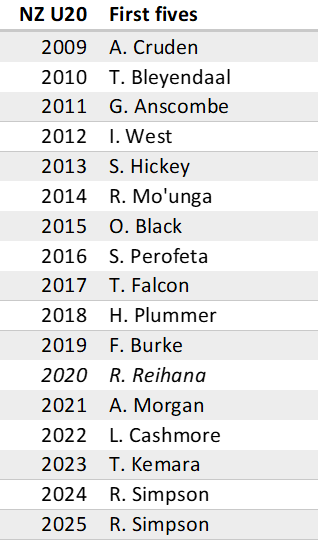
    If we look at who actually played first five for the U20s over the past 15 years, it becomes apparent that being selected for the age grade side is anything but a guarantee for future selections to the senior side.

    eb6c8613-cd27-4d8c-9162-313945bea1c5-image.png
    The list of NZ U20 10s who played the predominant role in the jersey. While no international tournament took place in 2020, Reihana was the most likely recipient of the role so I’ve included him here

    While the first few years of U20 rugby witnessed some success stories, like Cruden, Barrett, McKenzie and Mo’unga all becoming regular ABs, the final 10 years has barely delivered anything of note.

    268 minutes of Test rugby to be more precise – 264 of those belonging to Stephen Perofeta, the other 4 to Plummer – is all that is left to show for the past 10 years of NZ U20 first five development (2015-’25), with none of those minutes even coming from any meaningful time at 10. Meanwhile, 5 of those NZ U20 first fives are now playing overseas (Black, Falcon, Plummer, Burke and Morgan), with one (Burke, SCO) having already played for another country while 2 others might soon come into consideration (Black, Falcon, JP).

    Those that remained in New Zealand – Perofeta, Reihana, Cashmore, Kemara and Simpson – have struggled in their own way, with very few opportunities available to them. Perofeta has mainly featured at fullback for the Blues, while it took an injury crisis at the Crusaders for Reihana to finally get an extended shot at pivot at Super Rugby-level. Someone like Cashmore has even struggled to string together Super Rugby contracts, despite leading an NZ U20 attack which averaged 58 points per game at the 2022 Oceania U20 Championship. Who knows when Rico Simpson will get his shot, with both Beauden Barrett and Perofeta still ahead of him at the Blues.

    Muliaina will face a similar battle at the Highlanders, with Josh Jacomb arriving in 2027 and a rejuvenated Cam Millar looking to establish himself at Super Rugby-level in 2026 after finding his style of play at first five alongside Dylan Pledger at halfback in the NPC.

    30d68c33-0fca-46b2-ba85-7a54cb108c5d-image.png
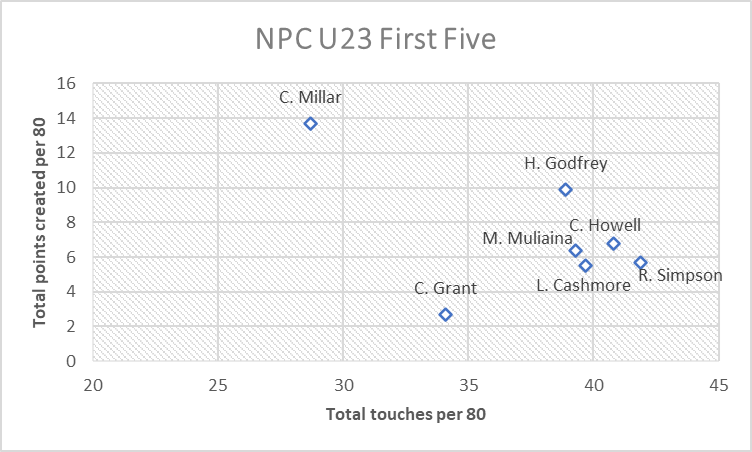
    Millar found his groove in the 2025 NPC: limit your touches and rack up the points. It was a solid formula for Otago which could potentially be replicated at the Highlanders next year

    2028 is looking like it will be the decisive year for future NZ 10s. With Barrett, Mo’unga and potentially even McKenzie looking to depart after the 2027 Rugby World Cup, there’s an opportunity for some new blood to finally establish itself both at SRP- and at Test-level. Muliaina would do well in the meantime to build up his own portfolio as much as possible. No better place to start than the 2026 U20 World Championships in Georgia.


  • NZ Sevens 2025-26
  • MaussM Mauss

    Tocker was pretty good for the NZ U18 team at last year’s Global Youth Sevens. I prefer him in the sevens format, as I think it’s a better fit for some of his strengths (e.g. high ball work on restarts) and his athleticism. He’s great in the lineout as well, he can get up very quickly and effectively contest opposition throws.

    That said, I don’t think he’s a like-for-like replacement with Rob Rush. Rush was really good at the breakdown in Dubai and I think that’s an area where Tocker still needs to improve quite a bit, especially in terms of the aggression and accuracy of his cleans. He also doesn't really play with the kind of abrasiveness that I associate with Rush. To my eyes, he's something in-between a forward and a back (which is also why I prefer him in sevens rather than the 15 man game).

    I do think Tocker could be a handy option, especially from the bench. And it's good to see some new faces in the sevens squad, they really needed to freshen up.


  • NZ U20s 2026
  • MaussM Mauss

    @Bovidae said in NZ U20s 2026:

    @Mauss Three of the NZ U20 loose forwards from this year are also eligible for 2026 - McLeod, Woodley and Fale. The latter seems to be used more as a no.8 now, so that could be your likely starting loose forward trio. Aio Keith was playing no.8 for the Auckland U19s.

    As you say, hopefully others will be identified that weren't involved in the U18 teams.

    McLeod’s also been playing at number 8 for Canterbury U19s and Crusaders U20s. I reckon he’s in with a good chance of not only playing there but also of captaining the side. That said, I do rate Fale really highly as well. There are plenty of good options in the loose forwards so they’ll need to find the trio that provides the best balance.

    It’s as you say, it will be in the tight five where the strength of the team will be decided. I think lock has reasonable depth. There’s Brown, Tatafu and Falloon, as you mentioned, as well as George Prouting and Jake Frost from Canterbury. Frost lacks height but he provides a lot of grunt and work rate. I’ve read some good things about North Harbour’s Preston Morunga but I haven’t seen him play yet.

    As far as props are concerned, tighthead is probably the big question mark for me. Johnston and Ahloo (’25 U20s) are good players but haven’t really been convincing in the set piece. I like the look of Ethan Webber (Otago U19, Māori U18) but he’s not the finished product either. My hope is that players like Kaiva Tulimanu (Westlake Boys, NZ Barbarian U18s) get more of a shot: he doesn’t look particularly athletic but he’s hard to move at scrum time and is a big body in the maul.

    But if recent selections are anything to go by, the NZ U20s emphasize mobility and work rate for the props rather than set piece ability. Can’t say I completely agree with that policy.


  • NZ U20s 2026
  • MaussM Mauss

    2026 should be an interesting year for the NZ U20s. It’s the age grade graduation of the 2024 U18 cohort, who lost rather convincingly to a touring Australian U18 side. With the top rep team, NZ Schools, losing not only to the Australians but to a Māori selection as well, expectations might not be too high for this particular age group when it comes to the upcoming U20 competitions.

    Then again, painful losses do create opportunities. I was watching some footage of Canterbury U19s recently and a player stood out to me who I hadn’t seen before. Frankie Meates, the Canterbury openside flanker, wasn’t selected for any of the representative teams in 2024. Instead, lining up in the 7-shirt were Aio Keith (NZ Schools), Micah Fale (NZ Barbarians U18) and Jayden Broome (Māori U18), all of whom will also come into consideration for next year’s U20 team, with Fale and Keith already earning selection honours in 2025.

    Had these rep teams been incredibly successful, it might’ve been challenging for Meates to force his way in. With the pathway rather struggling at U18 level as it is, however, we are looking at a much more open and level playing field.

    Meates made sure to take his opportunity during the U19 games, as he was close to irresistible for a dominant Canterbury side. The former Christ's College openside bears a strong resemblance to the typical Cantab flanker: he is effective when playing close to the ruck, both on attack and in defence, he runs immaculate support lines and he consistently flirts with the borders of legality. At the defensive ruck, he shows an excellent feel for the timing and mechanics of the breakdown, allowing him to earn holding penalties, pilfer the ball or just make a mess of opposition ball.

    https://media2.giphy.com/media/v1.Y2lkPTc5MGI3NjExOWZzcXU5cHhwd3NwdjM0b292ZDZpYXRvNGN2OXFheDJydXg1bXJsMyZlcD12MV9pbnRlcm5hbF9naWZfYnlfaWQmY3Q9Zw/B8IMWaY4rRTSMaZvRf/giphy.gif
    https://media0.giphy.com/media/v1.Y2lkPTc5MGI3NjExa3A4ZnVyN3BhN204eGg2d2lhbnF6MHlwaWQ1YWhtMjljNzgwOTZueCZlcD12MV9pbnRlcm5hbF9naWZfYnlfaWQmY3Q9Zw/gxFOWTgxBUr8gmtqN6/giphy.gif
    https://media1.giphy.com/media/v1.Y2lkPTc5MGI3NjExOWE0aDNybWdsc2xodnhmZ2w3YmxveTl4NnZ5M2ZhcjFpNWF1a2dkaCZlcD12MV9pbnRlcm5hbF9naWZfYnlfaWQmY3Q9Zw/KSD8DM00gkIbbECBmp/giphy.gif
    https://media4.giphy.com/media/v1.Y2lkPTc5MGI3NjExcWF4dXY1em41MjhtZDBkaHhxM3R3NWp0YTY0bmowandlcnJxcnZydSZlcD12MV9pbnRlcm5hbF9naWZfYnlfaWQmY3Q9Zw/psudfz6vY8xpcvUjjy/giphy.gif
    Meates being a menace at the breakdown

    What makes Meates somewhat more unique is that he complements this classical flanker skillset with a very complete attacking game, showing a turn of pace, step and fend that any back would be proud of.

    https://media4.giphy.com/media/v1.Y2lkPTc5MGI3NjExM2Z6c2NpMWtsNjhqczU3YTA2ZDUwZWVjdG9uMmdyeG5ycTRiamQzYiZlcD12MV9pbnRlcm5hbF9naWZfYnlfaWQmY3Q9Zw/uQwLaX0tTLNB9QWbna/giphy.gif
    https://media4.giphy.com/media/v1.Y2lkPTc5MGI3NjExZzFibTI0NWV1bGc4eHQ0NmYzMTZuM2JidGVrMDlqOTZwYnB3NzNieCZlcD12MV9pbnRlcm5hbF9naWZfYnlfaWQmY3Q9Zw/m0542dBMGzNzYE4rya/giphy.gif
    https://media2.giphy.com/media/v1.Y2lkPTc5MGI3NjExaXphNGd3MzFwN2V3OHQ3bXE2OTl6bWFlNzZwdnRoYmljZGZicTRhcSZlcD12MV9pbnRlcm5hbF9naWZfYnlfaWQmY3Q9Zw/oO6QHQavPyUp9b4MgJ/giphy.gif
    https://media2.giphy.com/media/v1.Y2lkPTc5MGI3NjExZ2E1NjZ5cDl2b3JpdThzaTV3Ym5jM2xiY3hxd2o2dXBlanBncG04ayZlcD12MV9pbnRlcm5hbF9naWZfYnlfaWQmY3Q9Zw/Qa8uTJv8PJ2Fmmsk41/giphy.gif
    Meates showing the skills of a back

    Meates isn't too dissimilar to the newest openside recruit in Christchurch, Oli Mathis, in that he could easily act as a forward/back-hybrid. He shows great ability to be effective on the edge, displaying a good understanding of space as well as the athleticism and distribution skills to make that space count.

    So how will the NZ U20s fare in 2026? Perhaps the poor results at U18 level from 2024 onwards have tempered expectations somewhat, with the NZ rep sides seemingly falling behind their Australian counterparts. And yet, this has potentially opened the door for players who weren’t yet firmly embedded within the national pathways, to stake their claim and to help right the ship. And, as Frankie Meates has shown for the Canterbury U19s, there are still plenty of talented players running around, hungry for their shot at glory in the black jersey.


  • England v All Blacks
  • MaussM Mauss

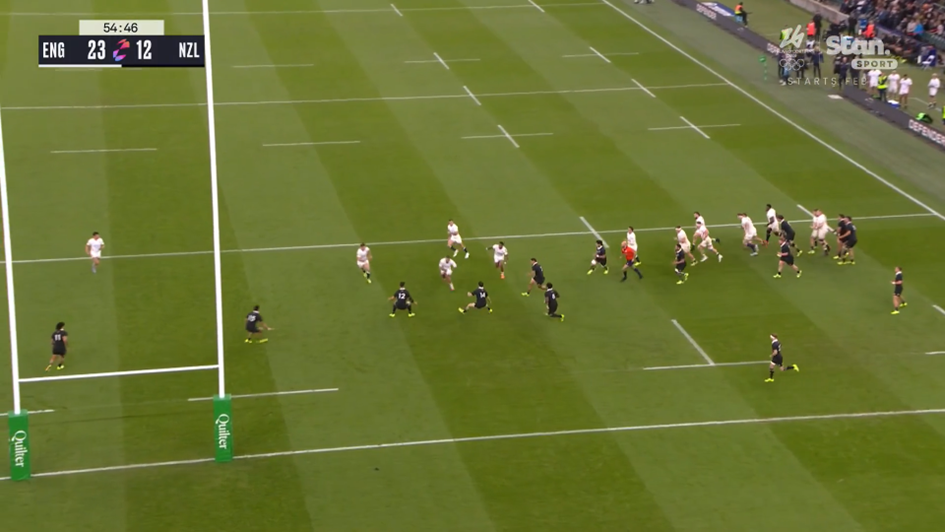
    I thought the Dingwall try was actually quite symbolic for some of the deeper-lying issues within this team. It shows that the players don’t trust each other and that the opposition is generally smarter than them.

    e7db1e7f-f7b0-4399-993a-800352e3cbbe-image.png

    It is honestly an embarrassingly easy score for England: Mitchell throws the long pass to Lawrence, taking out both Taylor and Lakai from the defensive picture. It leaves England and the ABs with a two-on-two: Lawrence and Dingwall against Carter and Tupaea.

    There is really no reason for Tupaea to bite in here, unless he doesn’t trust Carter to make the tackle on Lawrence. And that takes us all the way back to the try in the first half, where Carter gets flattened by the English centre. Tupaea gets a flashback, wants to put in a double shot, and then it’s just easy hands at the line for Lawrence. Proctor is far back because he’s covering the English attackers hidden in the boot; he’s trusting his teammates to execute the defensive 2-on-2.

    It's smart from England but it is painfully naïve from an AB perspective. Big, individual errors, like Leroy Carter’s in the first half, are a mental challenge for a team. If you’re a good side, you immediately put it behind you and start again. If you’re mentally fragile, it becomes like a domino-effect, influencing your every move and decision from that moment onwards.

    After the England Test, I think it’s pretty clear what kind of team these ABs are.


  • England v All Blacks
  • MaussM Mauss

    @nostrildamus said in England Vs All Blacks:

    @Mauss said in England Vs All Blacks:

    @pakman said in England Vs All Blacks:

    @Mauss I should have clocked that from the Gary Stevenson reference!

    I like him. Not so much as an economist per se. More as a sort of modern-day court jester. He’s like a character that’s jumped out of Brant’s Das Narrenschiff, a beautiful, bat-eared clown in these increasingly feudalistic times.

    Brant’s *Das Narrenschiff == Ship of Fools?
    With those sorts of high level references you're the Goff Whitlam equivalent of a modern rugby analyst. I just hope you're not Rocky 'Renaissance Man' Elsom!

    “The latest rugby analysis, now brought to you by the Service Pénitentiaire de Narbonne”?

    I wish.


  • England v All Blacks
  • MaussM Mauss

    @JA said in England Vs All Blacks:

    With the way game is going (if in doubt - boxkick it), I think this area is getting to be one of the core elements of the game on par with scrum/breakdown etc.

    That’s funny that you say this because I’ve started thinking about the kick-chase as the back equivalent of the lineout. Like the lineout, you have guys who are excellent on their own ball and then you have those who excel in defensive disruption.

    It’s actually quite rare – again, like the lineout – that you have players who truly excel in both attacking and defensive facets of the ‘set piece’, because the dynamics, game sense and skillset are so distinct from each other.

    I also think coaches are increasingly approaching it as a form of set piece, because a lot of strike moves have incorporated the box kick as a starting premise for the strike, similar to a lineout attack.


  • England v All Blacks
  • MaussM Mauss

    @pakman said in England Vs All Blacks:

    This seems to chime with your analysis:

    Check out Penaud's kick chase!

    Some interesting points in there. I don’t disagree with their take that Penaud is a somewhat lazy chaser but I do disagree with their claim that Le Garrec’s box-kicking was on point. Multiple of his box kicks were quite deep inside the Bok 22; not even Kolbe would’ve gotten there in time. Bielle-Biarrey, who puts in a lot more effort, wasn’t able to reach multiple Le Garrec kicks either.

    Also, their argument that Penaud’s lazy chase in the 2nd half – “3 steps worth of effort changed the game” – is not very convincing, as I felt that South Africa pretty much battered the French throughout that game. If it weren’t for that red card, I think you’re looking at a Wellington-type 2nd half for France.

    Their point about a changed French kicking game, and how it compounded certain errors in areas like defensive kick receipt, is well made though.


  • England v All Blacks
  • MaussM Mauss

    @pakman said in England Vs All Blacks:

    @Mauss I should have clocked that from the Gary Stevenson reference!

    I like him. Not so much as an economist per se. More as a sort of modern-day court jester. He’s like a character that’s jumped out of Brant’s Das Narrenschiff, a beautiful, bat-eared clown in these increasingly feudalistic times.


  • England v All Blacks
  • MaussM Mauss

    @pakman said in England Vs All Blacks:

    There's a correlation (at least in the US) between 'desirability' of location and the ease of blocking new buildings. Homelessness is more evident in affluent cities (than poorer ones), for example.

    I really need to work on my joke delivery.


  • England v All Blacks
  • MaussM Mauss

    @pakman said in England Vs All Blacks:

    @Mauss There's a very strong argument that rising house prices in 'desirable' places are linked globally to a plague of planning and health and safety regulations. In other words a supply problem.

    So kind of like a Weberian analysis where an overly rationalized society, enabled by a strict division of labour, produces an overly rigid bureaucracy that restricts the demand-oriented flow of resources?

    Or, to put it in rugby terms: that would be like a coaching team focusing on incredibly specific skills – say, I don’t know, falling offloads? – due to a highly rationalized training schedule, rather than allocate time and energy to an immediate, very obvious issue at hand, like, just to give an example, high ball-reception?

    I don’t know. That just doesn’t sound very plausible to me.


  • England v All Blacks
  • MaussM Mauss

    @Chris-B said in England Vs All Blacks:

    It would be interesting to do a detailed season-wide analysis of catching high balls to verify who is best (and worst). Not just a raw score of catches and drops - but, looking at catches in traffic and outcomes compared with expected outcomes - some sort of rational scoring system and commentary.

    Unfortunately, it would probably require "someone" to watch all the games again. Maybe he (or she!) can do it next year!

    That sounds like an awful lot of work for whoever you’re referring to.

    Anyways, speaking of unpaid labour and the exploitation of the working class, this whole high ball-discussion reminds me of a recent Gary’s Economics-video where he’s talking about the rising housing prices. He makes the point that everyone thinks their specific city has a housing crisis while, in reality, it’s a global issue, necessitated by the growing inequality between the ultrarich and the working poor. [Just in case I happened to have piqued someone’s interest, this is the video I’m referring to: youtube.co/watch?v=BTlUyS-T-_4]

    I think a similar misconception is at work in the high ball-discussion. The reality is that it’s not just the All Blacks who are experiencing a high ball-crisis. All teams are currently struggling with defensive kick receipts: Welsh fans are about ready to lynch Blair Murray, Freddie Steward shelled multiple high balls against the Wallabies on the 1st of November, Tom Wright didn’t catch a single attacking bomb against the Boks at Ellis Park, and, for the All Blacks XV, 6ft3 Chay Fihaki couldn’t deal with the England A aerials. Whether you're a tall high ball-expert or a scrumcapped Bok midget, the results will most likely be the same: you're going to drop more balls than you're going to catch.

    Right now, if your halfback has a solid kicking game, chances are you’re going to be handsomely rewarded for going to the boot. Quietly, box-kicking 9s have been making a clear comeback: Nic White was crucial for the Wallaby success against both the Lions and the Boks, Reinach’s contestable kicking has been instrumental in the post-Eden Park Bok resurgence, and someone like Ben Spencer, the 33-year old Bath halfback, has suddenly become an important piece within the English attacking puzzle.

    Galthié has already been criticized for quite a few selection errors against the Springboks but arguably his biggest one was selecting Le Garrec ahead of Maxime Lucu. Le Garrec’s kicks were consistently too deep at the Stade de France which gave the Boks backfield breathing space. Whenever the kicks were on the money, there was little that Kolbe, Willemse and Arendse could do against the French chasers.

    Anyway, all of this to say that this isn’t something uniquely pertinent to the All Blacks alone. But where the ABs have been lacking, I think, is in those moments right before and after high balls. What the ABs need to do, more than anything else, is work on their defensive retreat and make sure that any spilt ball from the high ball is cleaned up.

    This will be especially critical against England. The English chasers have very little interest in actually catching the ball: they will aim to flood the receipt space with their band of chasing wingers/flankers, making sure that the AB back 3 can’t catch cleanly. After that, they can either (1) attack the space behind themselves (see Pollock try against Wallabies) or (2) release the ball to a backline that is already expertly aligned by George Ford and ready to pounce.

    So in my view, while the catch is obviously important, it’s only the first step. What is as crucial, if not more, is the collective coordination both before and immediately after the catch. The AB backline will need to match the speed of English realignment and get off the line, making sure that England don’t have the clean width of the field to attack in these kinds of situations.


  • All Blacks XV 2025
  • MaussM Mauss

    @pakman said in All Blacks XV 2025:

    Would like to have seen Vakasiuola get some exposure, even as an apprentice.

    Haig's stats point to him focussing on 6?

    I agree on Vakasiuola. He doesn’t really fit the profile of your typical AB lock, in the sense that he doesn’t have that big engine (yet), but his carrying is a point of difference. He would fit really well with what the ABs are currently trying to do with their bench. I do think he’s in the frame but probably just a year too early.

    Haig, I couldn’t really tell you. He’s excellent in the lineout so could play both lock and blindside. To my eyes, he looks most comfortable in the middle of the field, just clearing bodies and playing that support role in set pods. He seems to get a bit lost in those looser roles. Now he might well improve in that area, I don’t know. He certainly has the physical tools to be a good blindside but I’m not sure whether the way a 6 typically operates in SR (especially NZ franchises) is a skillset that particularly suits him.

    It probably just depends on your loose forward trio: if you pair him with a 7 and an 8 who can take up these wide roles – like Casey and Howden – then I think it could work well. But if Withy and Stodart are your 7 and 8, then I’d put him at lock and pick a more typical edge forward at blindside.


  • All Blacks XV 2025
  • MaussM Mauss

    @pakman said in All Blacks XV 2025:

    Wow, that’s a lot to take in @mauss! I only saw highlights but the attacking structure was a notch up from first game, especially in H2. Fakatava stood out for me in highlights, which, as extensively noted elsewhere, often provide a misleading view.

    I don’t think it was perfect by any means – the AB XV didn’t hold on to the ball enough, in my view – but there was some really clever stuff in there, especially from set piece (there was a nice move from an attacking scrum as well in the first half – ball back inside to trailing blindside (Flanders) – which really should’ve resulted in a try).

    I just liked that they took some Schmidt-plays and implemented it into their own game. Like I said, shows a nice bit of pragmatism.

    Fakatava was good. Stuck to the game plan – threw another bridge pass which resulted in a try shortly before the end – and was accurate in his execution and decision-making. He has a real shot at usurping Ratima next year, if he continues his good form in Super Rugby.

  • Login

  • Don't have an account? Register

  • Login or register to search.
  • First post
    Last post
0
  • Categories
  • Login

  • Don't have an account? Register

  • Login or register to search.